

I own two Presto Poplite popcorn poppers right now. One lives on the kitchen counter, and a battered yellow one rides in the cabinet of our travel trailer. My sister Denise bought her first Poplite back in 2011 for her kids' sleepovers, and when she finally handed it down to her son last year, the motor still ran like new. That kind of staying power is rare in a kitchen gadget that costs less than a nice dinner out, and it's the main reason I keep pointing people toward this popper instead of the newer, fancier options.
But staying power isn't the same as perfection, and there are a few things about the Poplite that the glowing five-star reviews tend to skip right past. This isn't a six-month test drive. I've used this exact design, on and off, for close to a decade across three different units in two households, mine and my sister's. So consider this the honest rundown, the stuff nobody mentions before you plug this thing in for the first time.
The Quick Verdict
Loud, a little messy around the edges, and basically unchanged since the Reagan administration, but it still pops better popcorn for less money than anything else that plugs into a wall outlet.
Amazon Check Today's Price →Still the Popcorn Popper Everyone Eventually Buys Back
I've watched three friends buy a flashy air fryer or a stovetop kettle, get tired of the cleanup and the guesswork, and land back on this exact yellow popper within a year. If you're tired of chemical-lined microwave bags and want a bowl of popcorn in under three minutes, this is the tool that keeps earning its spot on the counter.
Amazon Check Today's Price on Amazon →How I've Actually Used It
Denise's unit has run at least once a week, sometimes twice, since 2011. Mine came into the house in 2019 after I got tired of buying microwave bags for my grandson Mateo's weekend visits. The third one lives in our 26-foot travel trailer and only gets used on camping trips, but it's popped popcorn on a picnic table more times than I can count, plugged straight into the trailer's outlet with an extension cord snaking out the door.
Friday nights at our house have had the same soundtrack for years: the whir of the fan, the rattle of kernels bouncing around the chamber, and Mateo standing on a step stool watching the first few pops fly up the chute. He's eight now and pops his own batch with me standing right next to him. That's a small thing, but it matters when you're picking a kitchen gadget for a house with kids or grandkids in it.
Across three units and roughly a decade of combined use, we've replaced exactly one part, a cracked measuring cup lid on Denise's original popper. The heating elements and motors are all original. I say that not to promise you'll get the same result, appliances vary, but it tells you something about how the design has held up under real, repeated use rather than a single unboxing video.
The One Thing Nobody Mentions in the Five-Star Reviews
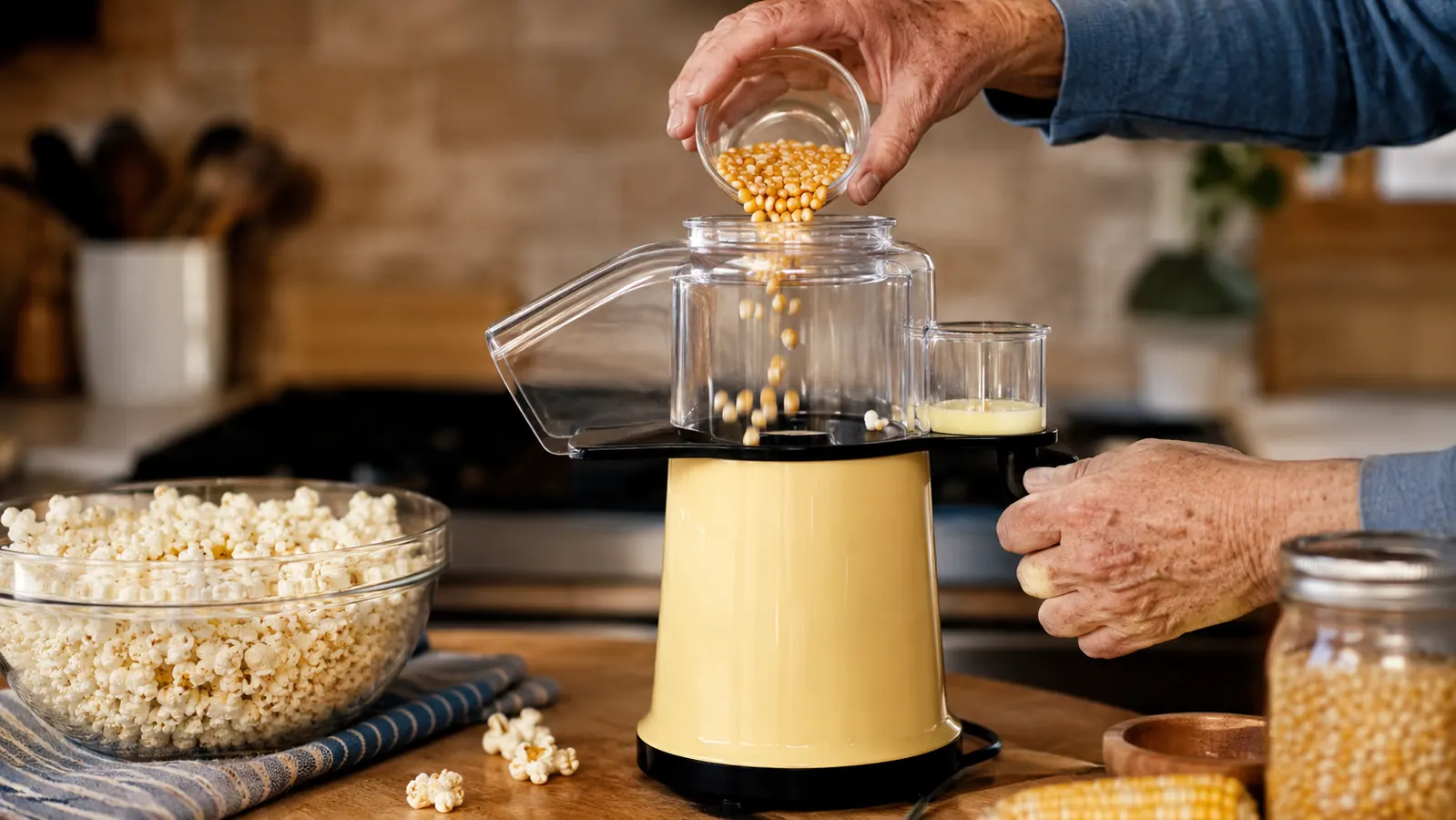
Here's the honest part almost every glowing review leaves out: this popper throws hulls and chaff well past the edge of the bowl if you don't center it exactly right under the chute. The first time I used mine, I had unpopped hull fragments scattered across the counter and, embarrassingly, a few that made it onto the floor near the fridge. It's not a defect. It's just how a gravity-fed hot air chute works when the popcorn is really moving.
The fix is simple once you know it: use a bowl at least two inches wider than the chute opening on every side, and don't walk away during the last thirty seconds of a batch, that's when the popping speeds up and kernels are most likely to bounce off the bowl's rim. I also keep a damp paper towel nearby, because the light, papery hulls have a habit of clinging to countertops with static and drifting further than you'd expect.
None of this is a dealbreaker. It's just the kind of detail you only learn by actually using the thing, not by reading a product description. If you go in expecting a completely contained, zero-mess process, you'll be a little annoyed the first time. If you go in expecting to sweep a few hulls off the counter afterward, you'll barely notice, and you'll adjust your bowl placement after exactly one batch.
It's Loud, and That's Not a Defect
People ask me if their popper is broken because it sounds like a hair dryer crossed with a leaf blower. Mine sounds exactly the same. My husband still complains about it during football games on Sundays, and I still tell him the same thing: that noise is the fan pushing hot air fast enough to pop corn without a drop of oil, and a quiet fan wouldn't do the job.
For what it's worth, Mateo loves the noise. He calls it the popcorn machine's engine and likes to stand back and watch it work like a little science experiment. If you're sensitive to kitchen noise, or you're popping popcorn in a house with a sleeping baby down the hall, plan around it. Otherwise, it's just part of the two-minute ritual, loud, then done, then quiet again, and the quiet part comes fast.
The Butter Trick Works, But Barely
The Poplite's built-in measuring cup doubles as a butter melter, you set a pat of butter in the cup while the popcorn is popping, and by the time the batch is done, the rising heat has supposedly melted it into a ready-to-pour topping. In practice, it half works. If the butter is already soft or at room temperature, it melts down nicely and drizzles over the popcorn in a thin, even layer that I actually prefer to microwaved butter.
If the butter comes straight from the fridge, though, you'll end up with a cup of mostly-solid butter chunks sitting in a little pool of grease, and you'll need to stir it or give it an extra minute before it's usable. I've learned to pull my butter out of the fridge when I start measuring the kernels, not after the popper is already running, and that small habit makes the whole thing work the way the marketing photos suggest it will.
It's a nice feature, and I use it most weeks, but I wouldn't call it the seamless one-step process some reviews describe. It's more like a helpful shortcut that still asks a little bit of you, and once you know the trick, it stops being a minor annoyance and turns into just another step in the routine.
Decades of the Same Design (For Better and Worse)
The Poplite has no on-off switch, no timer, no digital display, nothing. You plug it in, it runs, and when the popping slows to one or two kernels every few seconds, you unplug it. If you forget and leave it plugged in with an empty chamber, it will happily keep blowing hot air until you notice. That's the honest tradeoff for a design this simple: fewer buttons means fewer things that can fail, but it also means you can't walk away and trust a timer to shut it off for you.
I've come to appreciate that simplicity more than I expected to. There's no companion app, no confusing setting to remember, no plastic display that yellows and cracks over time like on some of my other countertop gadgets. You measure, you plug in, you unplug when it's done. My mother-in-law, who is in her eighties and avoids anything with more than one button, uses hers without ever asking me how it works.
The downside is that the design genuinely hasn't changed much since the 1980s, and it shows in small ways. The plastic housing is functional, not stylish. It only comes in a couple of colors. If you want a popcorn maker that looks like it belongs in a modern kitchen photo shoot, this isn't it. If you want one that just works every single time you plug it in, this is exactly it, and after a decade of ownership across our family, that's the tradeoff I'd make again.
The Cleanup Nobody Photographs
Nobody posts a picture of the cleanup, so here's mine: the base wipes down with a dry paper towel in about ten seconds, since the kernels and popped corn never actually touch the heating element or the housing itself. The clear plastic chute lifts off and rinses under the sink in under a minute. None of it is dishwasher safe, which surprised me the first time, since so many small appliances these days advertise dishwasher-safe parts as a selling point.
The measuring cup gets the greasiest, since it's also doing double duty as the butter dish, and I usually give it a quick hand wash with dish soap right after use rather than letting butter residue sit and harden. Total cleanup time across all three units, including the counter wipe-down for stray hulls, runs about three minutes. That's less time than it takes a bag of microwave popcorn to actually finish popping in some older microwaves.
The one habit worth building early: empty the chute completely between batches. A few unpopped kernels or hull fragments left inside from the last round can rattle around and scorch slightly on the next run, giving off a faint burnt smell that has nothing to do with the fresh batch. It's a thirty-second fix once you know to check for it.

What Breaks Eventually and What Doesn't
After close to ten years of combined use across three units, here's what actually failed: the thin plastic tab that the cord wraps around on the bottom of the travel trailer unit cracked after years of being coiled tight for storage between camping trips. That part is cosmetic, the popper still works fine, the cord just doesn't tuck away quite as neatly anymore. Denise also lost the little plastic lid to her measuring cup at some point in the last decade, though I honestly can't tell you when or how.
What hasn't failed, on any of the three units, is the part that actually matters: the motor and the heating element. Every popper still pops a full batch in under three minutes, still browns and pops nearly every kernel we pour in, and still runs quietly enough that a fan failure would be obvious immediately. For an appliance in this price range, that kind of core reliability is the whole ballgame, and it's the part five-star reviews rarely get to test, because they're written the week the box arrives.
What I Liked
- Motor and heating element have genuinely lasted years across all three units we own
- Pops a full bowl in under three minutes with no oil and almost no unpopped kernels
- Simple enough that an eight-year-old can pop his own batch with an adult nearby
- Built-in butter cup is a real convenience once you learn to soften the butter first
- Compact enough to store in a cabinet or an RV cupboard between uses
Where It Falls Short
- Hulls and chaff scatter outside the bowl if it isn't centered exactly under the chute
- No off switch, you have to unplug it or it keeps blowing hot air with nothing left to pop
- Butter cup only half-melts cold butter, so you need to plan a few minutes ahead
- Loud enough that it interrupts conversation or a TV show while it's running
- The plastic cord-wrap tab is thin and can crack after years of tight, repeated coiling
The Poplite has never once failed to pop a bowl of popcorn. It has, however, made a mess of my counter more times than I can count.
Who This Is For
This popper is for families who want a cheap, no-oil popcorn habit without thinking too hard about it, for grandparents who need something a grandkid can help operate under supervision, and for anyone with limited counter or cabinet space who doesn't want a bulky machine taking up a corner of the kitchen. It's also a genuinely good fit for campers and RV owners, ours has ridden along on more trips than I can count and never once complained about a bumpy road, a cramped cupboard, or an outdoor extension cord.
Who Should Skip It
If you want something you can start, walk away from, and forget about, this isn't it, there's no auto shutoff, so you do have to stay within earshot. If loud kitchen noise genuinely bothers you, or you're popping late at night in a small apartment with thin walls, you'll want to weigh that before buying. And if you're chasing a sleek, modern-looking countertop appliance for aesthetic reasons, the Poplite's decades-old plastic housing won't scratch that itch, no matter how well it performs underneath.
Ready to Trade Microwave Bags for the Real Thing?
Ten years, three units, two households, and the honest verdict is the same every time: it's not fancy, but it works, batch after batch, without the chemical-lined bag or the guesswork. If that sounds like the kind of reliable you're after, it's worth a spot on your counter.
Amazon Check Today's Price on Amazon →