
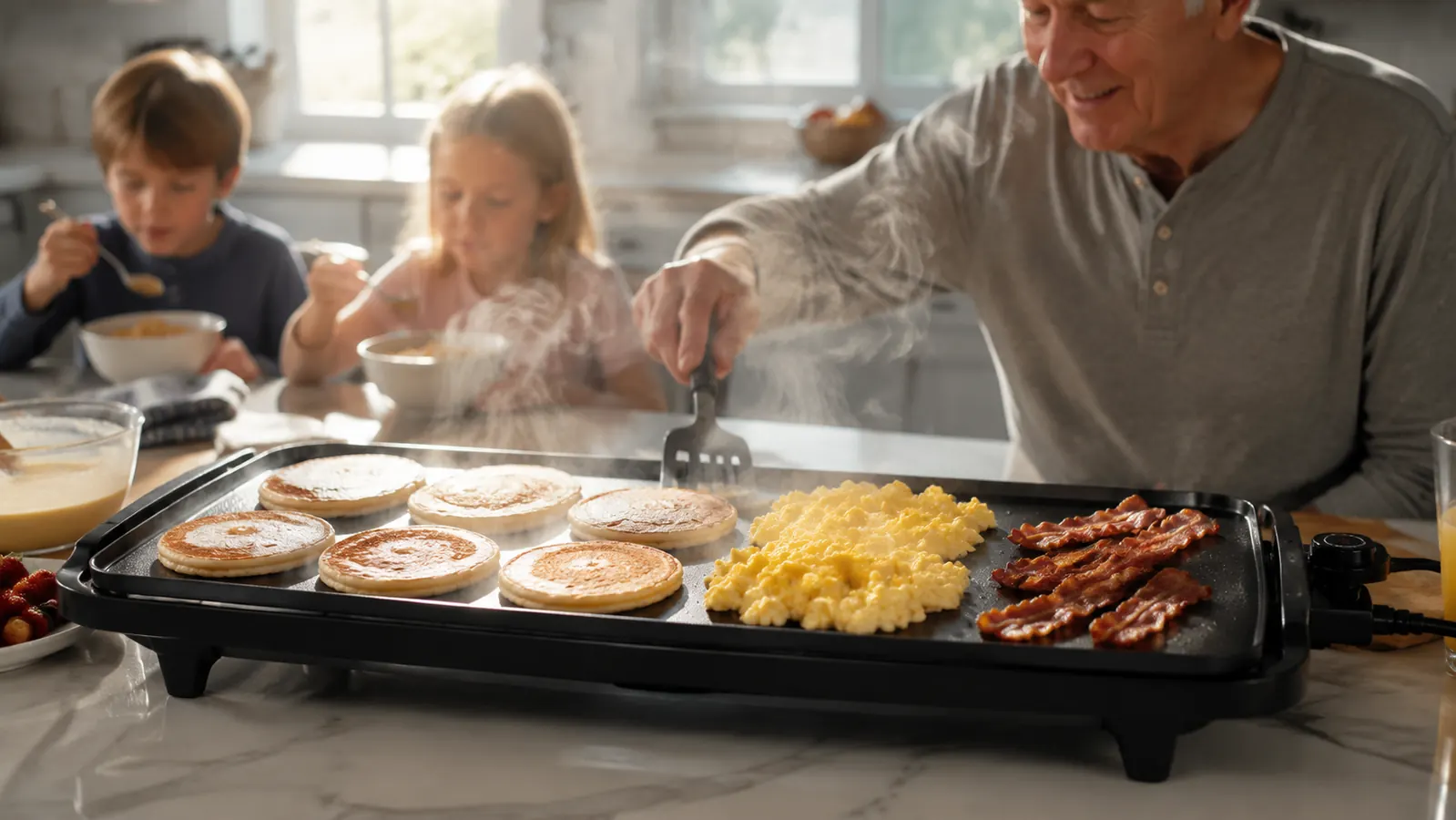
The first time I plugged in the Presto 22-inch griddle, it was for one reason: my daughter Kim was bringing her whole crew over, three kids under ten, and I was tired of standing at the stove flipping pancakes four at a time while everyone else's food went cold. That was six months ago. I've since used this griddle roughly ninety times, everything from single-serving Tuesday morning eggs to a Fourth of July breakfast for eleven people, and I finally feel like I can tell you the truth about it instead of the excitement of week one.
I'm not a professional reviewer. I'm a 63-year-old grandmother who cooks breakfast for family most weekends and wanted something that could handle a crowd without me babysitting three pans at once. If that's you too, this is the review I wish someone had written before I bought mine.
The Quick Verdict
A genuinely useful crowd-feeding tool that earns its counter space, with one real annoyance: the cord placement makes storage a small hassle.
Amazon Check Today's Price →Still flipping pancakes four at a time? There's a better way.
The Presto 22-inch griddle cooks a dozen eggs or eight pancakes at once, on one dial, with almost no hot spots. Check today's price and see if it's in stock.
Amazon Check Today's Price on Amazon →How I've Used It
I set the griddle up on my kitchen island for the first test run, plugged the temperature control into the side, and turned the dial to 375 like the included booklet suggested for pancakes. Six minutes later it was ready. I've since used it for pancakes, French toast, scrambled eggs, bacon, hash browns, quesadillas, and once, on a whim, a dozen grilled cheese sandwiches for a rainy-day lunch with the grandkids. It has not left my counter permanently since week two. I keep it tucked against the backsplash and pull it out three or four mornings a week.
The removable temperature probe is the part I was most skeptical about going in. On my old griddle from fifteen years ago, that piece always felt flimsy, like it would snap if you looked at it wrong. This one has held up fine through what I'd estimate is 200-plus insertions and removals for cleaning. It clicks in with a small twist and comes out clean.
I've also tested it outdoors twice, once on the back patio using an outdoor-rated extension cord for a July cookout, and once just checking whether the surface would hold up to sudden temperature changes when I moved it from a warm kitchen to a cooler garage in October. Neither situation caused any issues, though I'd stick to normal room-temperature use for daily cooking since that's what it's designed and rated for.
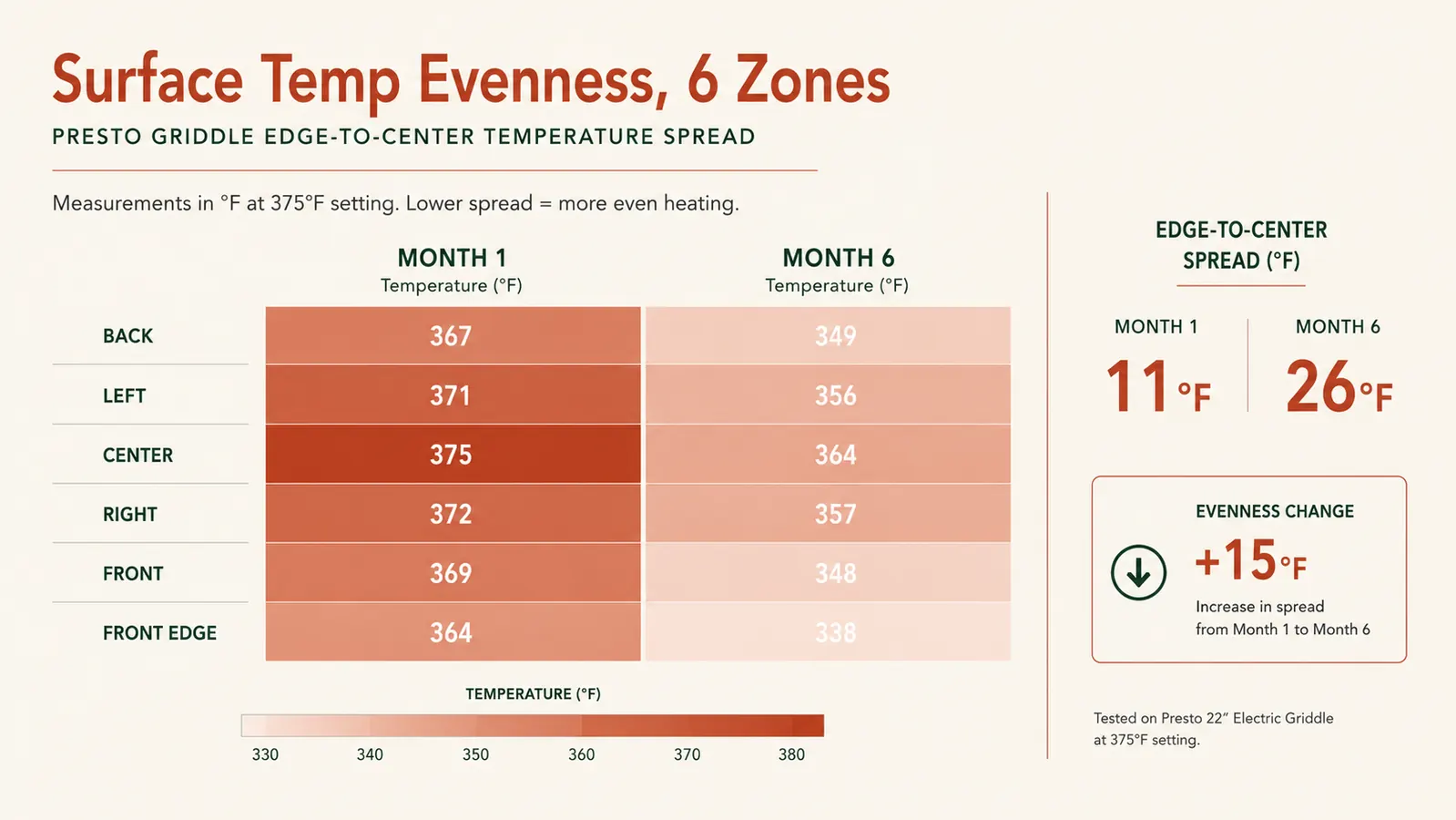
What surprised me most is how evenly the heat spreads. On my old stovetop griddle pan, the back-left corner always ran hotter, and I'd rotate food halfway through cooking out of habit. With the Presto, I stopped doing that around week three because I noticed pancakes on the edges were browning at nearly the same rate as ones in the center.
The Nonstick Surface, Six Months Later
This is the section I was most curious about myself. Nonstick coatings are the thing that makes or breaks a griddle like this, because once the coating starts to go, everything sticks and you're back to using a stick of butter just to keep eggs from welding themselves to the surface.
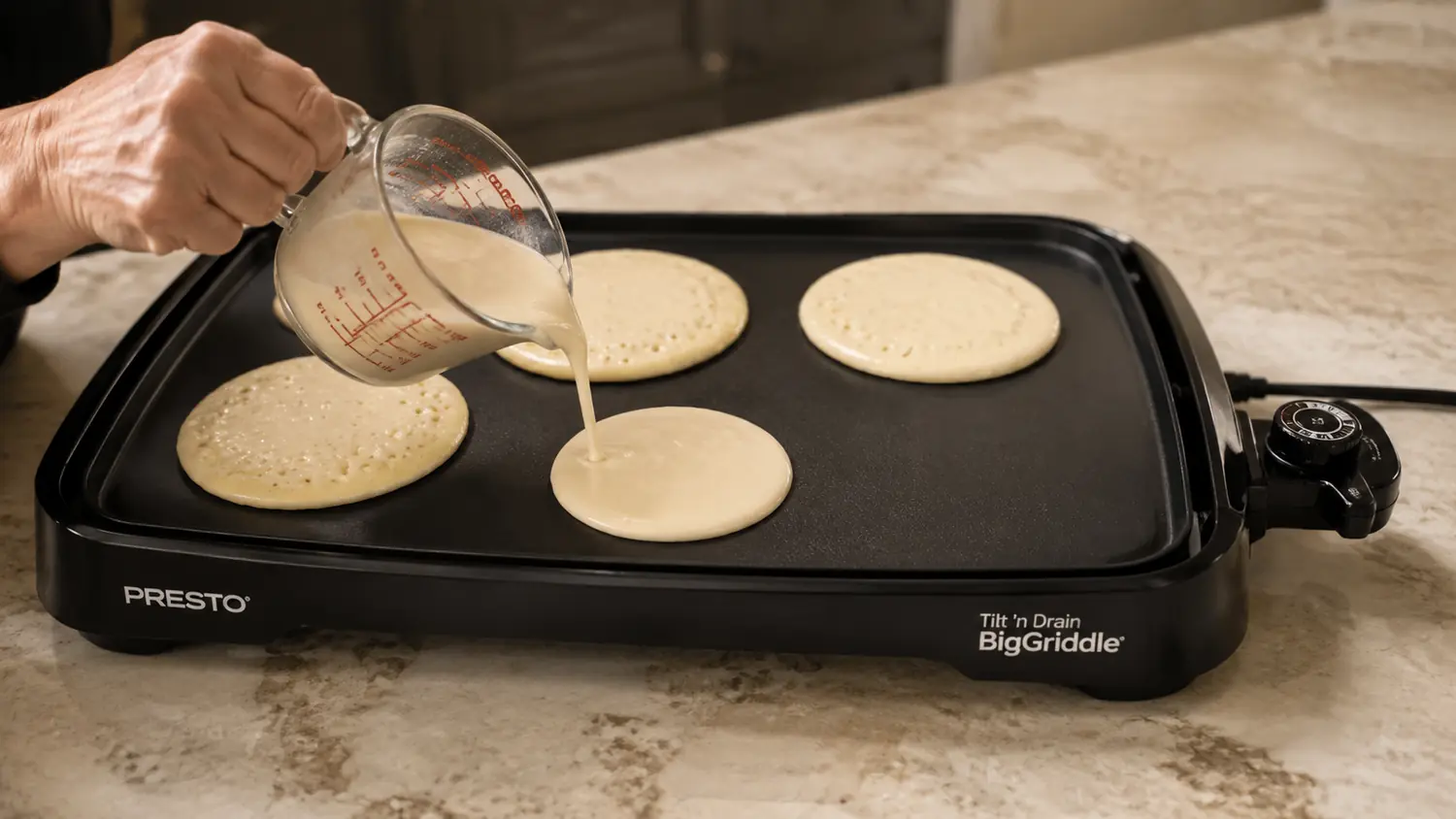
Six months and roughly ninety uses in, the ceramic nonstick surface still releases eggs without any butter or oil most mornings. I do use a light spray of avocado oil for pancakes, mostly out of habit, but I've tested cooking eggs dry a handful of times just to check, and they slide right off. There are two small areas near the front-right corner where I've noticed slightly more resistance, likely from where I scrape with a metal-edged spatula more often than I should. I've since switched to a nylon spatula and the wear seems to have stopped progressing.
I've also run it through the tougher tests: cheese quesadillas that bubbled over the edge, maple syrup that dripped straight onto the surface, and pancake batter with chocolate chips that always seem to melt and stick to any griddle I've owned. In every case, once the surface cooled enough to wipe down, the mess came off with a damp cloth and maybe thirty seconds of light scraping. That's a meaningfully lower cleanup effort than I remember from my old stovetop griddle pan, where burnt sugar could mean ten minutes of soaking.
For comparison, my sister has a similar-sized griddle from a different brand that she's owned about the same length of time, and hers already has visible scratching across the whole surface because she never switched off metal utensils. The lesson isn't really about the Presto specifically, it's that any nonstick surface needs a nylon or silicone spatula if you want it to last. Use metal and you're shortening its life no matter which brand you buy.
Cooking For a Crowd vs. Cooking For One
The griddle's full 22-inch cooking surface holds eight pancakes at once, or a dozen strips of bacon, or six eggs with room to spare for hash browns on the side. That's the whole point of buying something this size, and it delivers. When Kim's family of five came over for that first brunch, I had everyone fed and sitting down within twenty minutes of turning the dial on. Before, that same breakfast took me almost forty-five minutes of cooking in batches on two stovetop pans.
That Fourth of July breakfast for eleven people is probably the best stress test the griddle has had. I cooked four dozen mini pancakes, two dozen eggs, and two pounds of bacon across roughly ninety minutes, working in three big batches instead of the eight or nine smaller batches it would have taken on my old stovetop pans. Nobody waited more than a few minutes between plates, and the surface never seemed to drop in temperature even when it was fully loaded edge to edge.
On weekday mornings when it's just my husband Ray and me, the griddle feels a little oversized, honestly. I still use it because the cleanup is genuinely fast, but if you're cooking for one or two people most days and only occasionally for a crowd, you might get more practical daily use out of a smaller model and pull out something bigger for holidays. For us, the tradeoff is worth it because we host often enough that the extra size pays for itself in convenience.
Temperature Control and Consistency
The dial goes from warm up to 400 degrees, and I've settled into a routine: 325 for eggs, 375 for pancakes and French toast, and 400 for bacon when I want it crisp fast. The control unit has a small indicator light that clicks off when the surface reaches temperature, which took me a few uses to trust, but it's been accurate every time I've tested it against my old instant-read thermometer laid flat on the surface.
One thing I noticed around month four: preheating takes slightly longer in winter than it did over the summer, probably because my kitchen runs cooler with the AC off and the heat not yet kicked on. We're talking maybe two extra minutes, nothing that's changed my routine, but worth mentioning if you're the type who times things closely.
Cleanup, Storage, and the One Real Annoyance
Cleanup is the single biggest reason this griddle stayed on my counter instead of getting shoved in a cabinet after the first month. Once the surface cools, a damp cloth wipes up most of the grease, and for stuck-on bits I use the plastic scraper that came with it. The whole cooking surface is dishwasher safe once you unplug and remove the heating control, though I usually hand wash it because it dries faster and I'm not waiting for a dishwasher cycle to finish before I put it away.
Here's my honest complaint, and it's the same one I'd give any electric griddle this size: the cord and control probe stick out from one side, which means it doesn't stack flat against the wall in my cabinet the way I'd like. I ended up dedicating a spot in my pantry specifically for it, standing on its edge with the cord coiled loosely. It's a minor inconvenience, but if counter and storage space is tight in your kitchen, factor that in before buying.
I did eventually solve the storage annoyance by hanging a small adhesive hook inside my pantry door and looping the cord over it before setting the griddle down flat behind my baking sheets. It's a five-second fix, but it would have been nice if Presto had designed a spot to wind the cord into the unit itself, the way some newer countertop appliances do.

What I Considered Instead
Before I bought the Presto, I seriously considered two other routes. The first was a cast iron griddle that sits across two stovetop burners, which is what my mother used for forty years and swore by. I actually borrowed my neighbor's for a weekend test run. It heats beautifully and lasts forever, but it's heavy enough that lifting it on and off the stove became its own chore, and I never got comfortable managing two burners at slightly different temperatures to keep the surface even.
The second option was a smaller electric griddle, closer to 14 or 15 inches, sold by a couple of other kitchen brands at a similar price point. I almost went that direction because it seemed like less counter commitment. But when I ran the math on how many pancakes or eggs it could hold at once, roughly half of what the Presto handles, I realized I'd just be back to cooking in batches for anything bigger than a quiet weekday breakfast, which was the exact problem I was trying to solve in the first place.
Six months later, I don't regret going bigger. The extra size has paid for itself in mornings where I wasn't standing at the stove while everyone else's food got cold, and that was the whole reason I bought it.
What I Liked
- 22-inch surface cooks a full family breakfast in one pass
- Nonstick coating still releasing food cleanly after 6 months of regular use
- Even heat across the surface, no more hot-corner rotating
- Dishwasher-safe cooking surface once the control probe is removed
- Accurate temperature dial that's held up through daily use
Where It Falls Short
- Bulky to store because of the cord and probe placement
- Oversized for daily one-or-two-person cooking
- Metal utensils will wear the coating faster, nylon or silicone required
Before, breakfast for a crowd took me forty-five minutes of pan juggling. Now it's twenty, and everyone sits down to eat at the same time.
Who This Is For
If you cook breakfast for more than two or three people on any kind of regular basis, whether that's a big family, weekend guests, or a house full of grandkids on school breaks, this griddle solves a real problem. The size means you're not standing over the stove in batches, and the even heat means you're not scorching one side while the other stays pale. It's also a good fit if you're tired of replacing a cheap nonstick pan every year or two, because the surface has genuinely outlasted my expectations so far. And it's a smart pick if you're the designated breakfast cook for holidays and family gatherings, the person everyone expects pancakes from, because it takes the pressure off cooking in relays while guests wait at the table.
Who Should Skip It
If you live alone or cook for one or two people almost every day, the 22-inch surface is more griddle than you need for daily use, and the storage footprint might not be worth it just for occasional guests. A smaller 15 or 16-inch griddle, or even a good nonstick skillet, would serve you better day to day. I'd also skip it if you know you won't switch to nylon or silicone utensils, because that's the fastest way to shorten the life of any nonstick surface, this one included. And if counter space or cabinet storage is already tight in your kitchen, measure twice before buying, because a 22-inch griddle needs a real home when it's not in use.
Six months in, it's still the first thing I reach for on a full-house morning.
If you're feeding more than a couple of people at breakfast on a regular basis, this is the griddle that gets everyone fed at the same time. See current availability and today's price.
Amazon Check Today's Price on Amazon →