
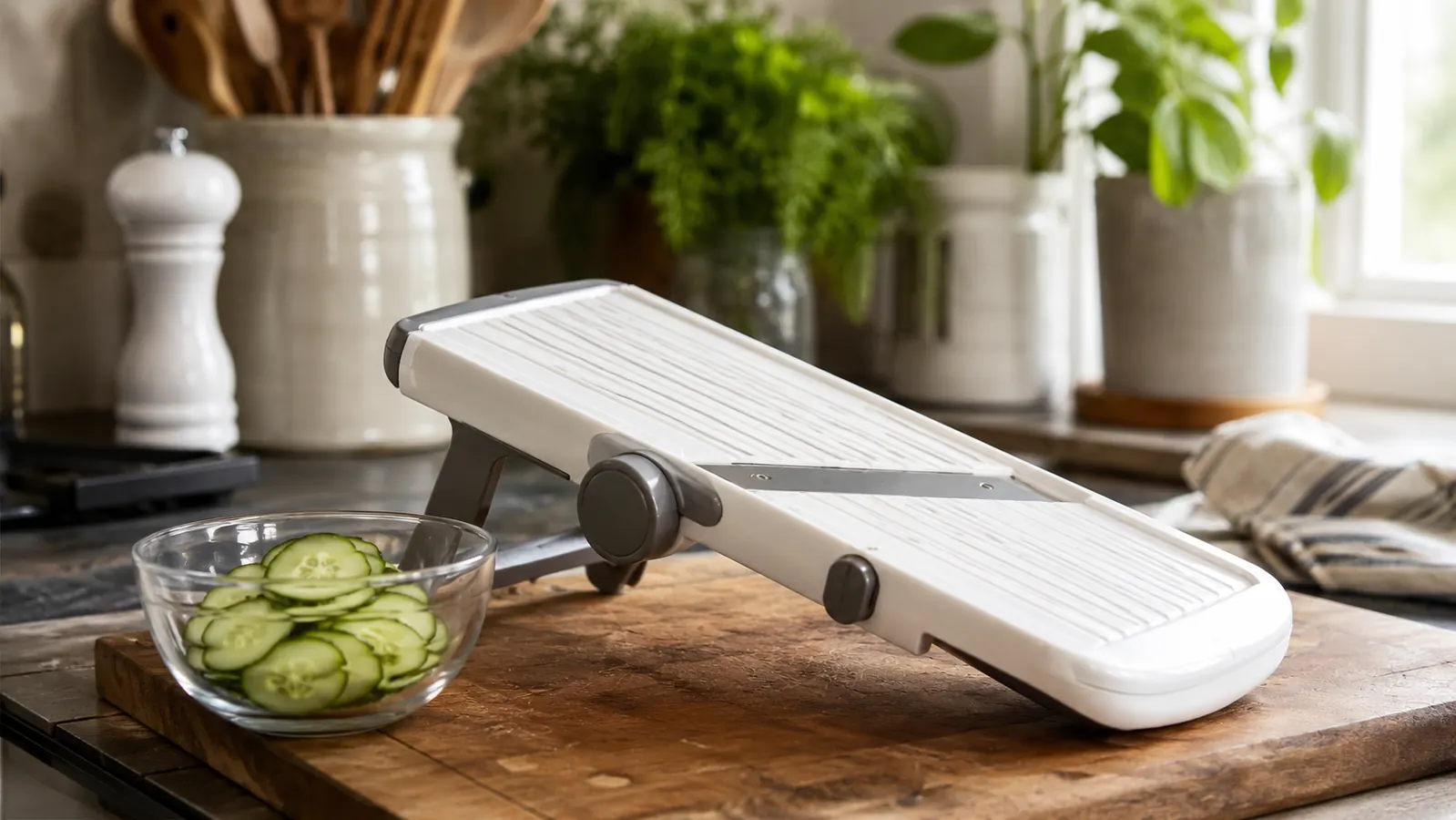
I want to say the true thing right up front, because most of what I read before I bought the OXO mandoline skipped it entirely. This tool will slice a potato into paper-thin, restaurant-quality rounds in about ninety seconds. It will also take a piece off your thumb just as fast if you get lazy with the food holder, and not one of the glowing reviews I read before buying mentioned that plainly. I've had mine in my kitchen drawer for a while now, used it for scalloped potatoes, coleslaw, gratins, and a batch of zucchini chips that didn't quite work out, and I want to walk you through what actually happens once the box is open.
This isn't a takedown. I still reach for it more often than I expected to when I bought it. But I bought this on the strength of a lot of five-star praise about how sharp and consistent the blade is, and almost nobody mentioned how sharp really translates in practice, or how the thickness dial behaves once you're three vegetables into a real recipe instead of a demo video. If you're deciding whether this belongs in your kitchen, you deserve the version with the fine print included.
The Quick Verdict
The slices are genuinely restaurant-quality and the build feels sturdy for the cost, but the blade guard takes real practice to trust, and the thickness dial isn't quite as precise as the numbers suggest.
Amazon Check Today's Price →See what the OXO mandoline actually costs today
Prices shift, and Amazon's current listing will always be more accurate than anything printed here. Worth a quick look before you decide.
Amazon Check Today's Price on Amazon →How I've Used It: What I Wish Someone Had Told Me First
I picked this up after a bad Thanksgiving. I'd volunteered to make scalloped potatoes for eighteen people and spent nearly an hour with a chef's knife trying to get consistent, thin rounds so the dish would cook evenly. Half of them turned out thick and undercooked, half turned to mush, and I decided right then that I needed a real slicing tool instead of relying on my knife skills, which, at seventy, aren't what they used to be.
What nobody told me in those reviews is that a mandoline this sharp changes how carefully you have to move, not just how fast you can chop. It's not like a food processor where the blade is tucked away behind a lid. The blade sits exposed on an angled ramp, and your job is to keep your hand above the safety line every single time. That sounds obvious written out like that, but it took me two uses to actually internalize it, and I'll get into why below.
My daughter-in-law Colleen bought the same model about a month after I did, based on how much I'd raved about my scalloped potatoes. She called me a week later, a little sheepish, to ask if a small nick on the side of her palm was normal. It was, in the sense that it happens to a lot of first-time mandoline users, but it shouldn't have happened at all if the reviews she'd read had actually walked her through the food holder properly instead of just praising the blade.
Since then I've used mine on a fairly regular basis, at least once a week, sometimes more around the holidays. I've run it through potatoes, cucumbers, onions, cabbage, zucchini, and one attempt at apples for a galette that came out beautifully even. That range of vegetables matters, because a tool that only performs well on firm potatoes isn't nearly as useful as one that handles the soft stuff too, and I wanted enough real hours on it before I'd trust myself to write any of this down.
The Blade Guard Nobody Warns You About
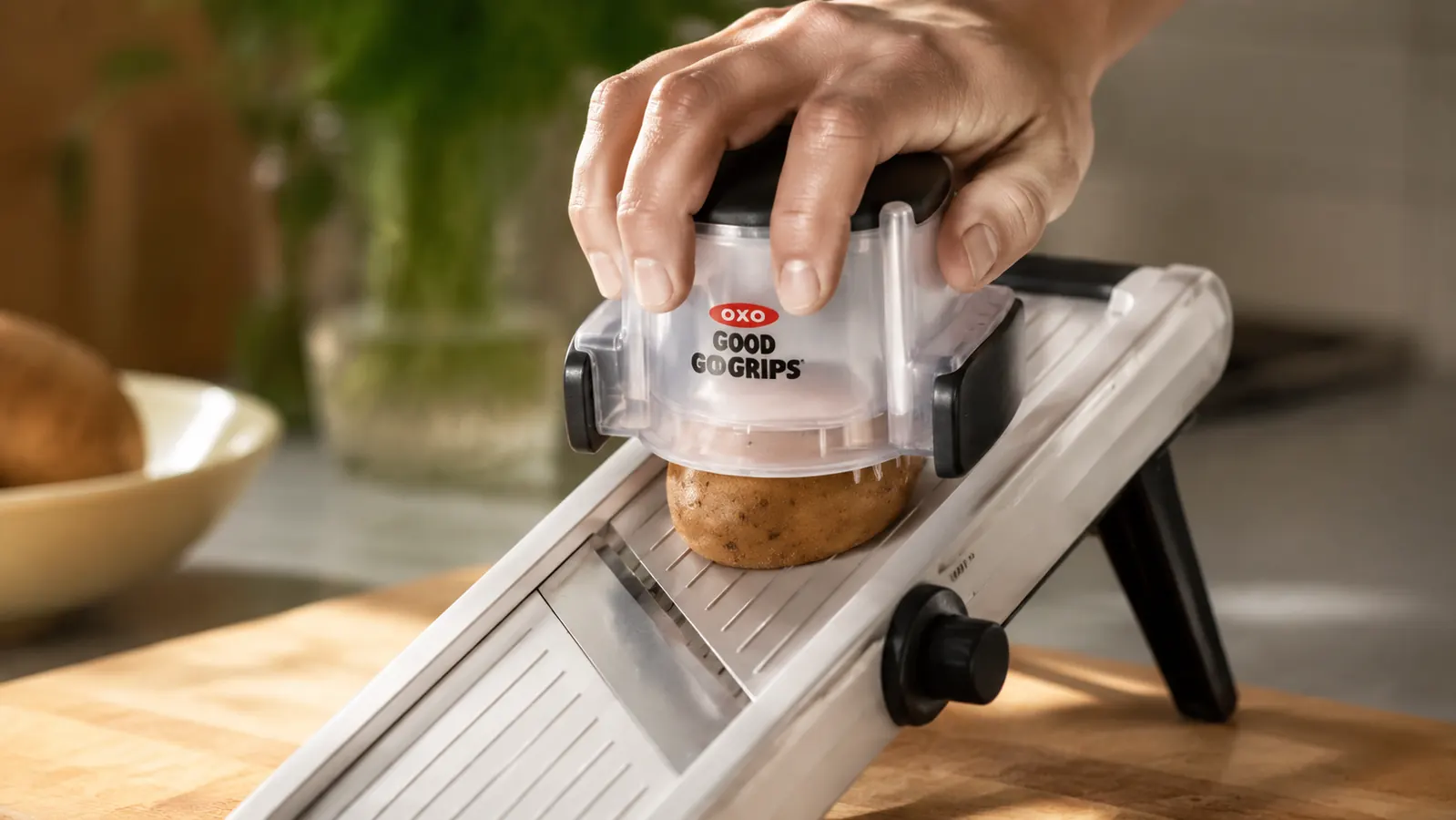
Here's the part I most wish someone had spelled out before I used mine the first time. The OXO comes with a plastic food holder, a little handle with small prongs that grip the vegetable and hold your hand well above the blade. It works. But it's not intuitive on the first try, and the instructions in the box are brief. I didn't seat my first potato firmly enough into the prongs, it wobbled halfway down the ramp, and I instinctively reached in with my other hand to steady it. That instinct is exactly what gets people cut, and I stopped myself about an inch from the blade, close enough that it scared me more than the actual near-miss should have.
So here's my actual hand-safety rule, the one I now follow every single time without exception: never let any part of your hand cross the plane of the blade, full stop, even to steady a wobbling vegetable. If something isn't gripped well by the food holder, stop, remove it, and reseat it properly rather than reaching in to fix it mid-slide. I also bought a cheap cut-resistant glove for about the cost of a cup of coffee, and I wear it on my guiding hand every time I use this tool, including for cleanup, which I'll get to. It isn't required by the manual, but I don't think anyone should use a mandoline this sharp without one, especially anyone with arthritis or reduced grip strength, which describes a fair number of people my age.
The blade itself is genuinely sharp enough that it doesn't feel like a kitchen tool so much as a specialized instrument. It glides through a raw potato with almost no resistance, which is exactly what makes it so good at its job and exactly why respect for it matters more than the reviews let on. I'd rather you read this paragraph twice before your first use than learn the hard way like Colleen did.
The Thickness Dial Isn't as Precise as It Looks
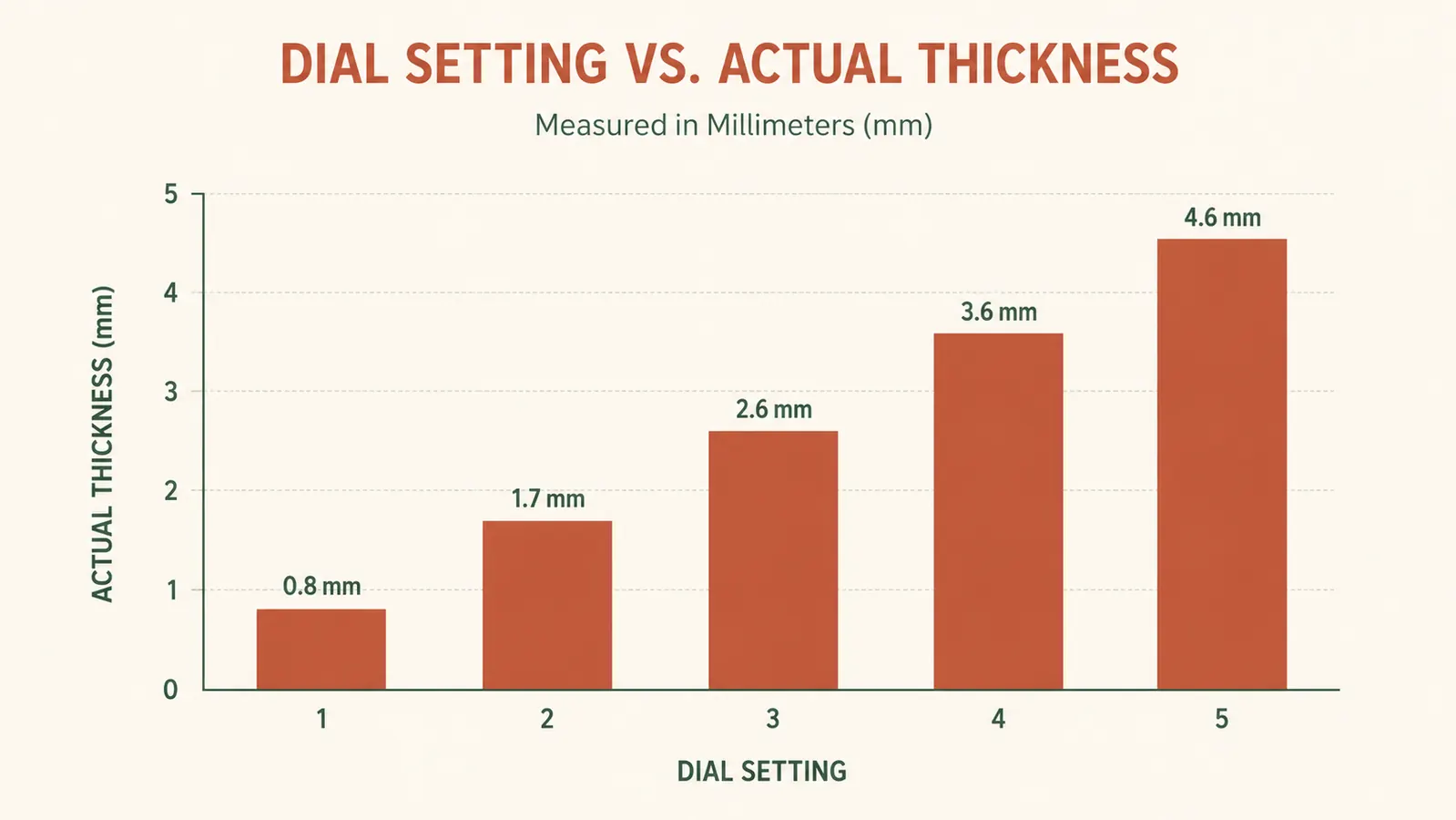
This surprised me more than the blade guard, honestly. The dial has clean numbered settings from 1 through 5, plus a julienne option, and it looks like it should give you exact, repeatable thickness every time. In practice, it's close but not exact. I measured slices at each setting with a small kitchen ruler out of curiosity, and the gap between the marked setting and the actual thickness widened noticeably at the thinner end of the dial, right around where you'd want it for a proper potato gratin.
Part of this comes down to the vegetable itself. A firm russet potato slices more consistently than a softer zucchini, which tends to compress slightly under the blade angle and come out a touch thicker than the dial number suggests. Once I understood that the dial is a starting point rather than a guarantee, I started doing a quick test slice on scrap before committing to a full batch, the same way you'd test a griddle's actual heat instead of trusting the dial number blindly.
None of this ruins the tool. But if you're the type who needs exact, uniform thickness for something like a professional-looking potato gratin, plan on a test slice or two at the start of each session rather than trusting the number cold. It's a five-second habit once you build it in, and it's saved me from an uneven batch more than once.
Cleaning It Is Its Own Small Ritual
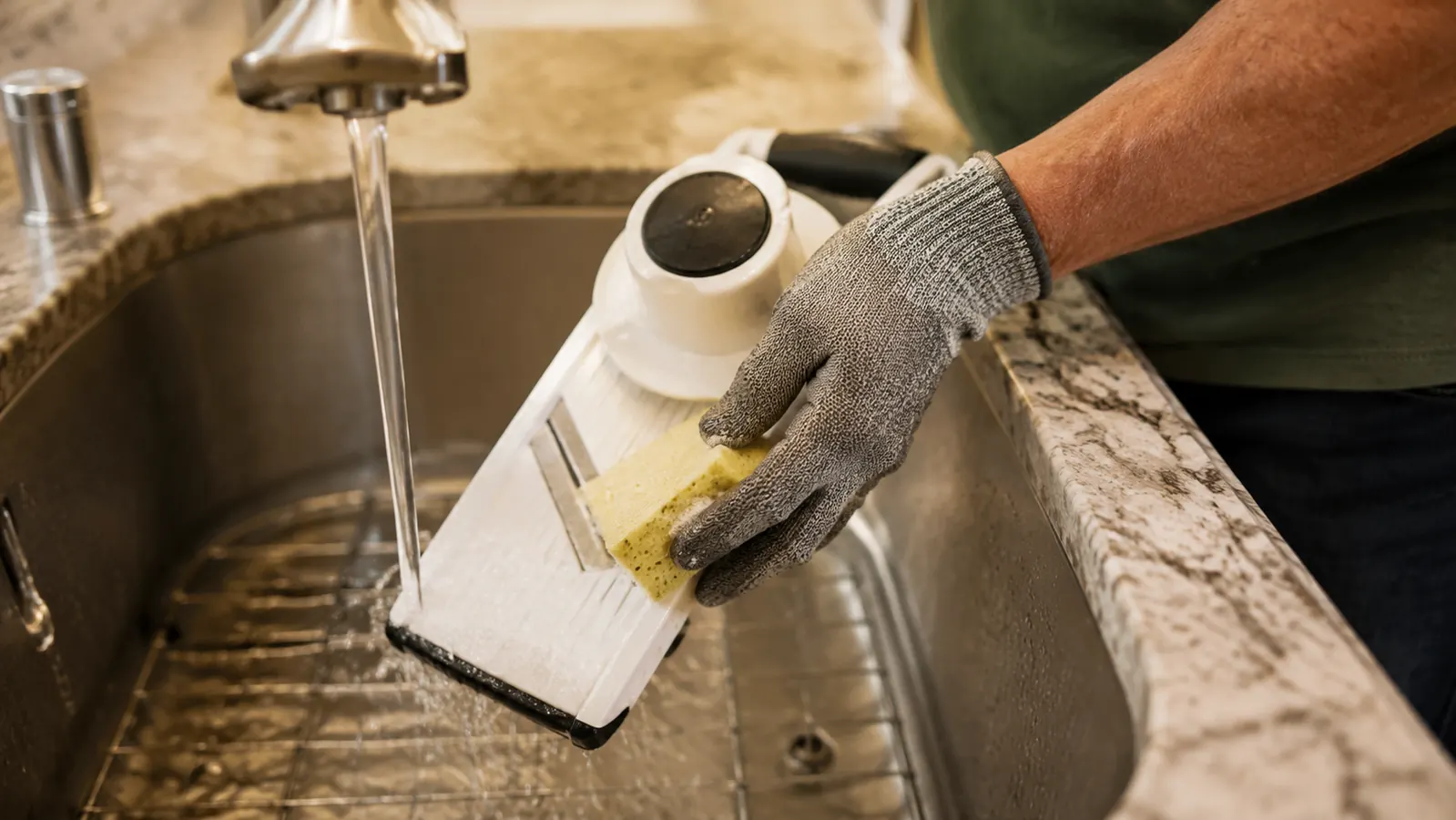
The manual says it's dishwasher-safe on the top rack, and mine has gone through the dishwasher without any warping or dulling that I've noticed. But I don't actually put it in the dishwasher most of the time, because loading and unloading a rack with an exposed blade sitting in it feels like an unnecessary risk when I'm also reaching around it for plates and cups. Instead, I hand-wash it, and this is where the cut-resistant glove earns its keep a second time.
My routine now is simple. Glove on, blade held pointing down and away from my body, a soft sponge run along the blade edge in one direction only, never back and forth, then a good rinse and a spot on the drying rack away from where my grandkids reach for cups. It takes about a minute once you've done it a few times, but it is genuinely the one task in my kitchen where I never let my guard down, because a wet, soapy blade is even less forgiving than a dry one.
Storage is worth a mention too, since nobody talks about it. This isn't something you toss loose into a utensil drawer with your spatulas and whisks. It came with a thin plastic blade guard that slides over the cutting edge, and I use it every single time it goes back in the drawer. I also keep it in its own separate section, away from anything I'd reach for quickly without looking, because a quick blind reach into a drawer is exactly how you'd find that blade the hard way.
What Actually Impressed Me
Now for the part the five-star reviews get right, because there's a real reason this thing has thousands of them. The slices genuinely are restaurant quality. Uniform, thin, clean edges every time, no ragged knife marks, no potatoes cut lopsided because my hand got tired halfway through. My scalloped potatoes cook evenly now for the first time in years, and my coleslaw has the kind of consistent julienne cabbage I used to only get from a restaurant.
The build itself feels sturdy in a way a lot of kitchen gadgets in this range don't. The base has rubberized feet that grip the counter and don't slide around while I'm working, which matters a lot when you're applying downward pressure with a blade this sharp underneath. I've also dropped it once, onto a tile floor, and it didn't crack or chip, which told me something about the plastic housing quality that I didn't expect going in.
The julienne blade caught me off guard too, in a good way. I expected it to be a gimmick attachment I'd use once and forget, but it's turned out to be the setting I reach for most, mostly for coleslaw and stir-fry vegetables. It produces clean, matchstick-thin strips in one pass that would have taken me ten slow minutes with a knife, and it's the single feature that's made this tool earn a permanent spot in the drawer rather than a shelf in the garage.
It's also genuinely fast once you're comfortable with it. A whole potato, sliced thin and even, takes me under a minute now, including setup. That speed is the entire reason I bought it, and it delivers on that promise completely, as long as you respect the blade the way I've described above.
What I Liked
- Slices come out restaurant-quality thin and consistently even
- Sturdy build with rubberized feet that stay put during use
- Full potato sliced and ready in under a minute once you're practiced
- Blade guard sleeve makes drawer storage reasonably safe
- Julienne setting genuinely useful, not a gimmick attachment
- Handles firm vegetables like potatoes and zucchini very well
Where It Falls Short
- Blade guard food holder takes real practice before it feels trustworthy
- Thickness dial runs slightly off true at the thinnest settings
- Softer vegetables compress and slice a touch thicker than the dial suggests
- Requires full attention every single use, no distracted slicing
The blade is exactly as good as everyone says. It just doesn't forgive a wobble the way a butter knife would.
What I Looked At Before Choosing This One
Before landing on the OXO, I looked at a couple of cheaper plastic mandolines at a local kitchen shop and one stainless steel V-blade model online with noticeably worse reviews around the food holder cracking after a few months. The cheap plastic ones felt flimsy in my hands, the kind of tool where the blade angle isn't locked in tight enough for consistent slices, and a couple of reviewers mentioned the blade loosening over time.
I picked the OXO mostly on build quality and the reputation of the brand for kitchen tools that hold up. It cost more than the plastic options, but between the sturdier housing and the food holder that hasn't shown any wear, I think it was the right call for how often I actually use it. If you only plan to slice vegetables once or twice a year for a holiday dish, a cheaper option might make more sense, but for regular use, the extra durability has paid for itself in fewer replacement purchases.
Who This Is For
If you cook dishes that depend on uniform, thin slices, gratins, scalloped potatoes, coleslaw, homemade chips, this earns its space in your kitchen fast. It's especially useful if your knife skills have slowed down with age or a hand condition, since it does the precision work a steady blade hand used to handle, as long as you follow the safety habits above. Anyone who hosts regularly and wants prep time cut down without sacrificing presentation will get real use out of this.
It's also a smart pickup if you're cooking for someone on a modified diet that calls for uniform portion sizes, since consistent thickness makes it much easier to judge cook times and calories at a glance. I've found that useful myself since my doctor put me on a lower-sodium plan that leans heavily on fresh vegetables instead of canned ones.
Who Should Skip It
If the idea of an exposed, very sharp blade sitting on your counter makes you nervous, or if you know you'll be tempted to skip the food holder for a quick shortcut slice, I'd genuinely pass on this one. It's also not the right fit if you need exact, lab-precise thickness every time without a test slice first, since the dial is close but not perfect. And if you're buying this for one big holiday meal a year, a simpler handheld slicer with a lower price tag might make more sense than a tool built for regular use. This is a tool for people who'll respect it every time, not just the first time.
Decide for yourself with the current listing
I've told you the safety habit and the dial quirk most reviews leave out. If the tradeoff still sounds worth it for the slice quality, the listing has the full specs and current availability.
Amazon Check Today's Price on Amazon →